> ## Documentation Index
> Fetch the complete documentation index at: https://docs.casebender.com/llms.txt
> Use this file to discover all available pages before exploring further.
# Observable Types
> Configure and manage observable types to categorize and track different types of indicators in your threat intelligence.
## Overview
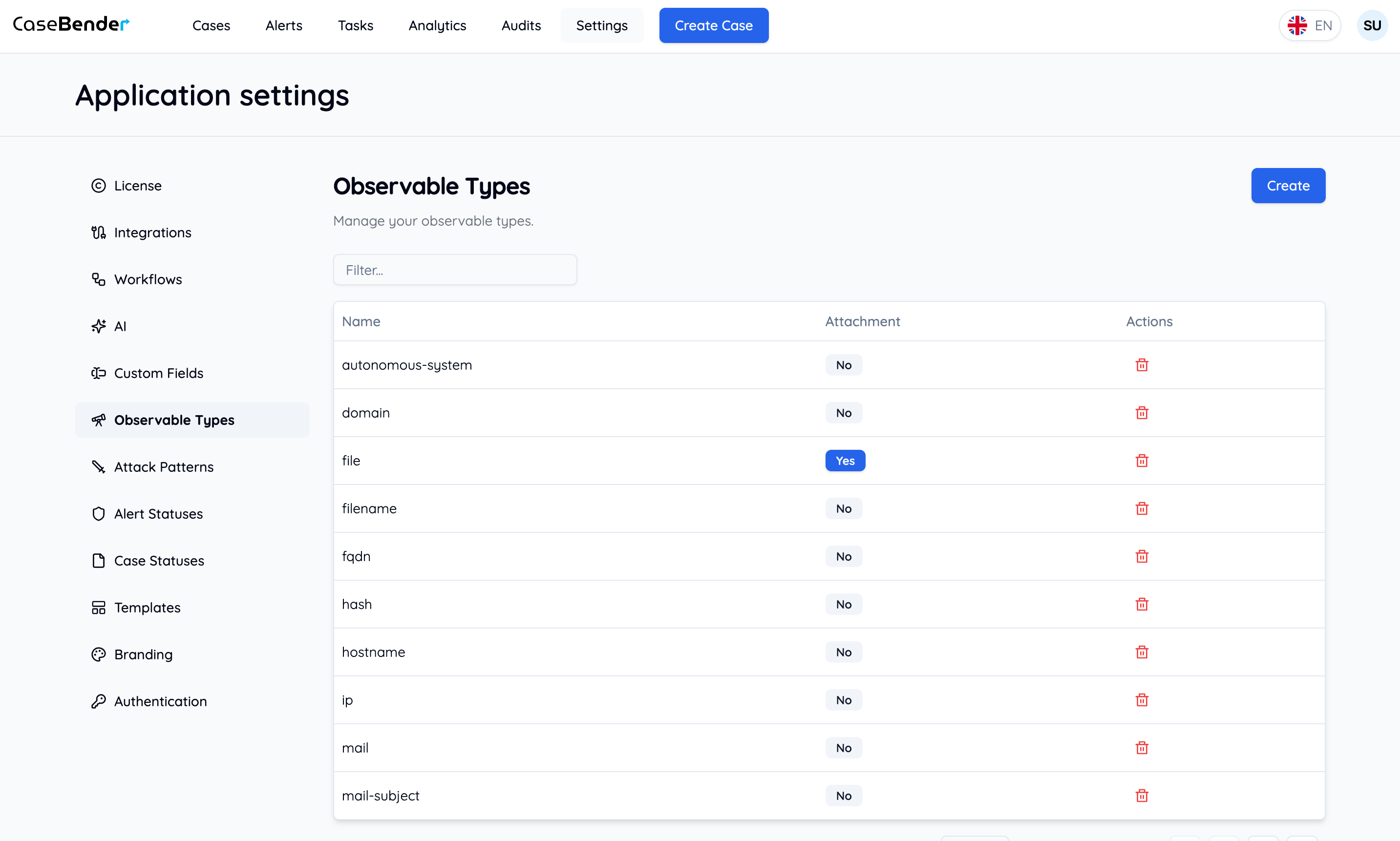
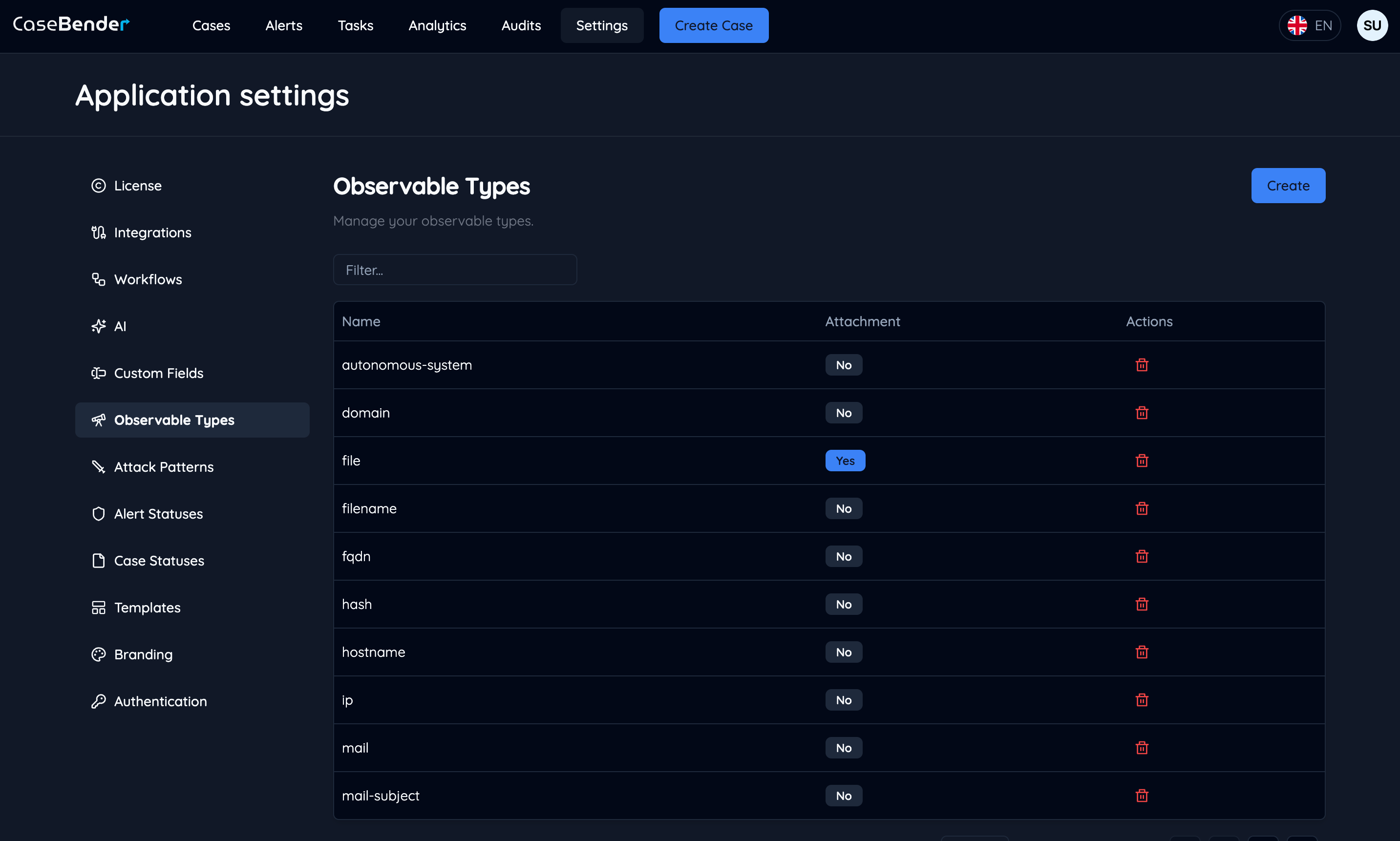
The Observable Types section allows you to define and manage different types of observables that can be tracked in your threat intelligence operations. These types help categorize various indicators such as IP addresses, domains, file hashes, and other digital artifacts that you monitor.
 ## Managing Observable Types
### Creating a New Type
Click the "Create" button to add a new observable type:
## Managing Observable Types
### Creating a New Type
Click the "Create" button to add a new observable type:
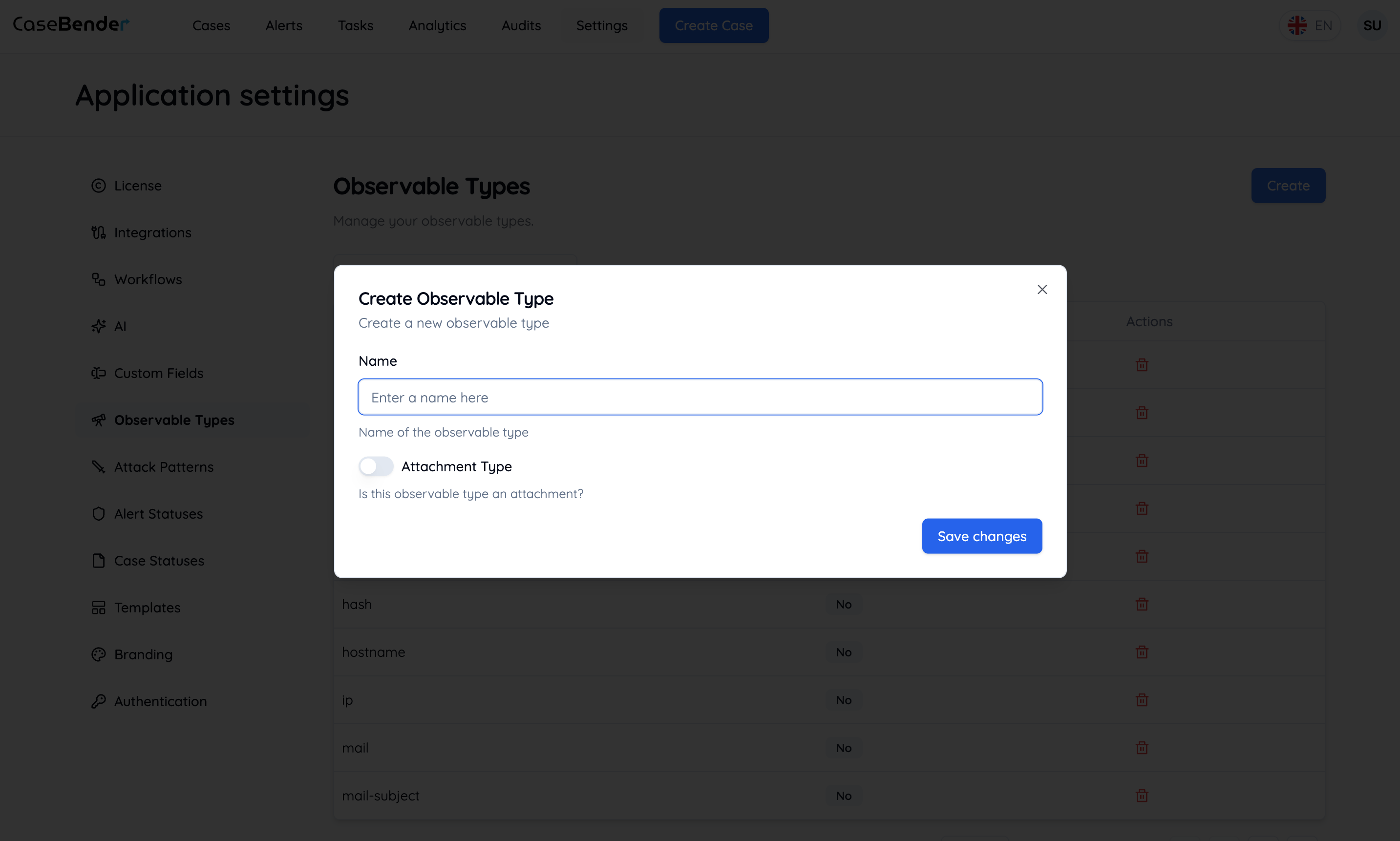
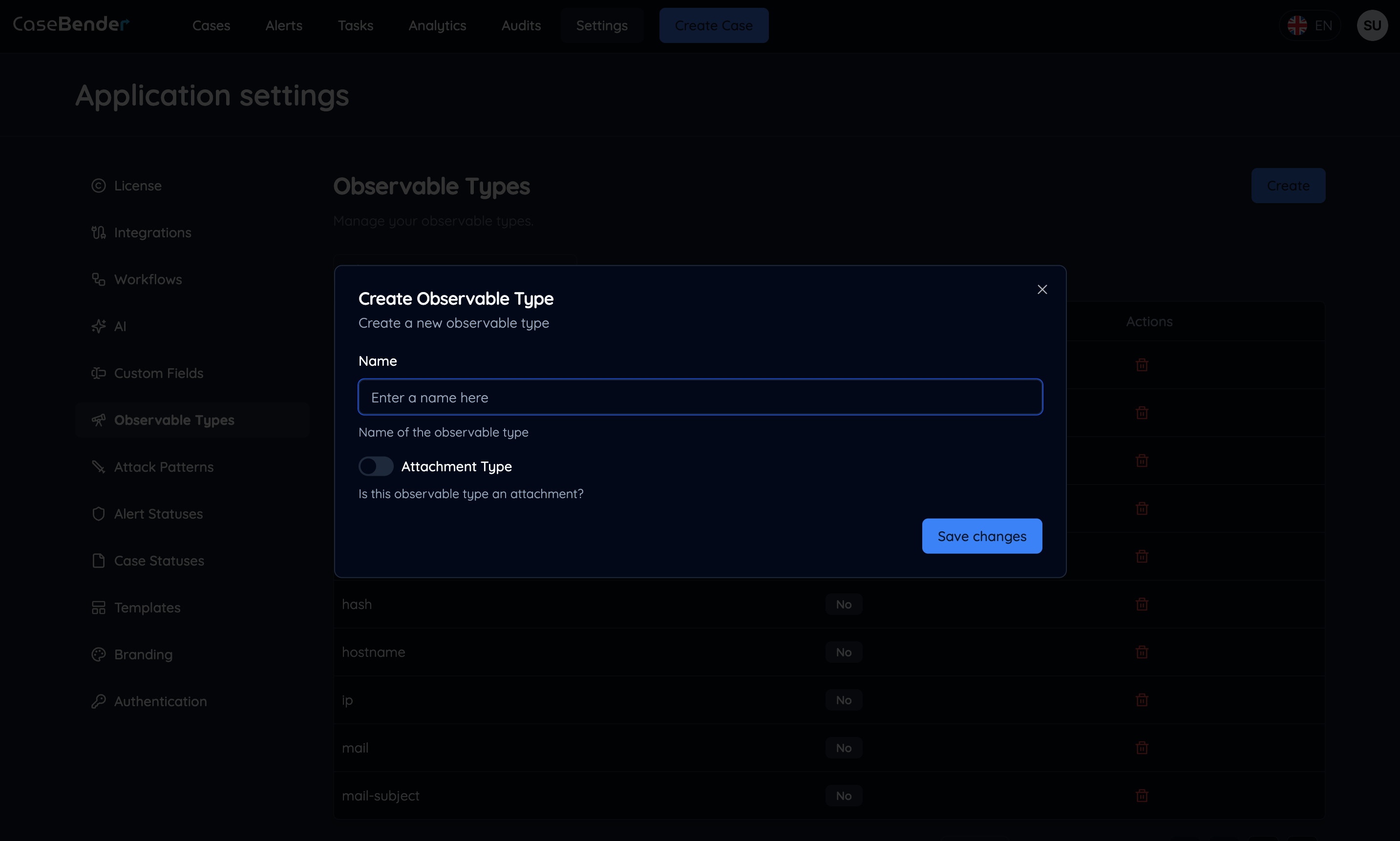 Configure the following settings:
* Type name
* Description
* Category
* Validation rules
* Display format
## Common Observable Types
### Network Indicators
* IP Address
* IPv4 format
* IPv6 format
* CIDR notation
* Domain Names
* Fully Qualified Domain Names (FQDN)
* Wildcards
* IDN support
* URLs
* Web addresses
* URI patterns
* Protocol specifications
### File Indicators
* File Hashes
* MD5
* SHA-1
* SHA-256
* SHA-512
* File Names
* Extensions
* Patterns
* Regular expressions
* File Paths
* Directory structures
* Path patterns
### System Indicators
* Registry Keys
* Windows registry paths
* Value names
* Data types
* Process Names
* Executable names
* Command lines
* Process patterns
* Service Names
* Windows services
* Unix daemons
* Service patterns
### Communication Indicators
* Email Addresses
* Address formats
* Domain validation
* Pattern matching
* User Accounts
* Usernames
* Account IDs
* Platform identifiers
* Communication Protocols
* Port numbers
* Protocol identifiers
* Service definitions
## Best Practices
### Type Definition
* Use clear, descriptive names
* Provide detailed descriptions
* Set appropriate validation rules
* Include example values
### Organization
* Group related types
* Maintain consistent naming
* Use categories effectively
* Consider type relationships
### Validation Rules
* Define format requirements
* Set value constraints
* Configure pattern matching
* Implement data validation
### Maintenance
* Review type usage
* Update definitions
* Document changes
* Monitor effectiveness
## Using Observable Types
### In Cases
* Threat indicators
* IOC tracking
* Evidence collection
* Pattern matching
### In Analysis
* Indicator correlation
* Pattern detection
* Threat hunting
* Intelligence gathering
### In Reports
* Indicator statistics
* Type distribution
* Trend analysis
* Intelligence reporting
## Related Documentation
* [Case Management](../../cases/introduction.mdx)
Configure the following settings:
* Type name
* Description
* Category
* Validation rules
* Display format
## Common Observable Types
### Network Indicators
* IP Address
* IPv4 format
* IPv6 format
* CIDR notation
* Domain Names
* Fully Qualified Domain Names (FQDN)
* Wildcards
* IDN support
* URLs
* Web addresses
* URI patterns
* Protocol specifications
### File Indicators
* File Hashes
* MD5
* SHA-1
* SHA-256
* SHA-512
* File Names
* Extensions
* Patterns
* Regular expressions
* File Paths
* Directory structures
* Path patterns
### System Indicators
* Registry Keys
* Windows registry paths
* Value names
* Data types
* Process Names
* Executable names
* Command lines
* Process patterns
* Service Names
* Windows services
* Unix daemons
* Service patterns
### Communication Indicators
* Email Addresses
* Address formats
* Domain validation
* Pattern matching
* User Accounts
* Usernames
* Account IDs
* Platform identifiers
* Communication Protocols
* Port numbers
* Protocol identifiers
* Service definitions
## Best Practices
### Type Definition
* Use clear, descriptive names
* Provide detailed descriptions
* Set appropriate validation rules
* Include example values
### Organization
* Group related types
* Maintain consistent naming
* Use categories effectively
* Consider type relationships
### Validation Rules
* Define format requirements
* Set value constraints
* Configure pattern matching
* Implement data validation
### Maintenance
* Review type usage
* Update definitions
* Document changes
* Monitor effectiveness
## Using Observable Types
### In Cases
* Threat indicators
* IOC tracking
* Evidence collection
* Pattern matching
### In Analysis
* Indicator correlation
* Pattern detection
* Threat hunting
* Intelligence gathering
### In Reports
* Indicator statistics
* Type distribution
* Trend analysis
* Intelligence reporting
## Related Documentation
* [Case Management](../../cases/introduction.mdx)